Showing posts with label Pledge. Show all posts

Thursday, November 20, 2014

The Freedom from Religion Foundation (FFRF) has been quite busy


FFRF combats ‘pervasive religious endorsement’ in Texas school district
A national state/church watchdog has lodged a formal complaint over "pervasive religious endorsement" by the Mt. Vernon Independent School District in Texas.

The Freedom From Religion Foundation contacted the district Oct. 31 on behalf of a local complainant. FFRF, based in Madison, Wis, has more than 21,500 members, including 900 in Texas. Numerous allegations of Establishment Clause violations include religious postings in several classrooms,,,

[,,,]
"Public schools have a duty to ensure that 'subsidized teachers do not inculcate religion' or use their positions of authority to promote a particular religious viewpoint," FFRF Staff Attorney Sam Grover wrote Superintendent John Kaufman in the Oct. 31 letter. "When teachers place Latin crosses or bible quotes on classroom walls, they have unconstitutionally entangled the school with a religious message, specifically a Christian message."
FFRF protests many police chaplains nationwide, including in Orlando
The Freedom From Religion Foundation, a national state/church watchdog, sent a letter and open records request to the Orlando Police Department (Fla.) on Nov. 3, objecting to the department's chaplain program. The complaint is the latest in a series of objections over law enforcement chaplaincies the FFRF has lodged this year.
,,,
Orlando chaplains, as is typical, are required to be ordained ministers with experience as pastors, who counsel employees, employees' families, and victims of crimes, and assist with death notifications and other police activities. Orlando's chaplain program does have one distinct feature – a car with an "Orlando Police Chaplain" graphic displayed across the side. FFRF's records request asks for documents relating to this car, as well as many other aspects of the chaplain program.
,,,
Some chaplain programs have other troubling elements, like chaplains delivering prayers at department ceremonies, or training law enforcement officers on subjects outside their expertise such as ethics and stress management. Some chaplains have contact with juveniles. A chaplain was photographed at a session of the Police Department's "Police Explorers" program in Dunwoody, Ga., whose participants are ages 14-21. The job description for Rochester's Clergy Response Team says that clergy "may volunteer in high schools with School Resource Officers." And Millville's chaplains made headlines in August for actually picking up and detaining children who had violated curfew.
,,,
Attorney Andrew Seidel, one of five FFRF staff attorneys, handled most of the chaplain complaints on behalf of FFRF. His letters explain that courts allow government-employed chaplains only as an accommodation where the government makes it difficult for people to seek out private ministries, as is the case with military service members or prisoners. Since there is no government-imposed religious burden on law enforcement officers or the public, the government does not need to provide chaplains for them.
FFRF reports electioneering churches to IRS
Prior to Tuesday's elections, FFRF passed onto the IRS nine complaints about churches improperly endorsing or opposing candidates for political office. FFRF is investigating further complaints that came to light this week.

All 501(c)(3) nonprofits, including churches, are prohibited from intervening in any election or engaging in partisan politicking, such as by supporting or opposing specific candidates. "The regulations ensure that 501(c)(3) groups do not abuse the public trust, since tax exemption is a privilege and a form of public subsidy," explains FFRF Co-President Annie Laurie Gaylor.

Many electioneering complaints stem from pastors who purposely violate electioneering restrictions from the pulpit as part of "Pulpit Freedom Sunday," an annual event put on by the Alliance Defending Freedom, a Christian Right group. ADF and their allies argue that religious groups should be given special treatment, and be allowed to engage in partisan activity while maintaining their tax-exempt status. Many pastors, at the urging of ADF, have sent videos of their lawbreaking sermons directly to the IRS, hoping to incite a legal challenge to rescind the 1954 law against politicking by 501(c)(3) churches. According to ADF, more than 1,700 pastors participated in Pulpit Freedom Sunday in October.
Ala. commission rescinds $3,000 faith grant to Baptist ministry
The Covington County Commission in Andalusia, Ala., voted unanimously Nov. 6 to rescind a $3,000 donation of taxpayer funds to the Covington Baptist Association for a men's ministry whose purpose was "to get more men to church."

The vote was in response to an Oct. 27 complaint letter from the Freedom From Religion Foundation protesting the flagrant constitutional violation.

Katherine Paige, FFRF legal fellow, sent the commission a second complaint letter Nov. 7 after learning that Commissioner Harold Elmore might ask to renew the grant to the ministry under the guise of funding building renovations.

Paige investigated property records and learned that Elmore was an incorporator of the Judson Baptist Church, which owns the building (sometimes referred to as the "Old Stanley School" or the "Stanley Community Center") and runs the ministry. Elmore serves as church deacon and is one of the Covington Baptist Association's four trustees.

"The commission cannot escape the grant's religious purpose and Commissioner Elmore's involvement raises serious ethical concerns under Alabama law," wrote Paige.
FFRF stands up for students’ right to omit “under God” from pledge
The Freedom From Religion Foundation yesterday sent a strong letter to the Tracy Unified School District (Calif.) censuring the punishment of two West High School students who omitted the words "under God" from the Pledge of Allegiance.

Students in Shauna Baker's speech and debate class are charged with the responsibility of reading the daily announcements and the Pledge of Allegiance over the loudspeaker to everyone in the school as part of a graded assignment. Juniors Adrianna Teboe and Derek Giardina recently left out the words "under God" when it was their turn to recite the pledge.

Both students were marked down a grade for the omission, according to news reports. Giardina was reportedly given detention when he failed to include the phrase a second time, and Baker told him if he did not say the pledge properly, he would be suspended and kicked out of class.

"Students should not be singled out for exercising a conscientious objection to the words 'under God,' " wrote FFRF Legal Fellow Katherine Paige, pointing out that the phrase was only belatedly added to the previously secular pledge in the 1950s.
FFRF faults 7th Circuit timidity on clergy privilege case
Freedom From Religion Foundation Co-Presidents Dan Barker and Annie Laurie Gaylor, who learned today a three-judge panel of the 7th U.S. Circuit Court of Appeals says they have no right to challenge the discriminatory "parsonage exemption," expressed disappointment that the court is unwilling to confront "this blatant preference for ministers and churches."

The panel, in a unanimous decision by Circuit Judge Joel Flaum, vacated a strong ruling a year ago by U.S. District Judge Barbara B. Crabb for the Western District of Wisconsin, declaring unconstitutional 26 U.S. C. § 107(2), passed by Congress in 1954.

The law allows "ministers of the gospel" paid through a housing allowance to exclude that allowance from taxable income. Ministers may, for instance, use the untaxed income to purchase a home, and, in a practice known as "double dipping," may then deduct interest paid on the mortgage and property taxes.

"It's important to note," said attorney Richard L. Bolton, who handled the litigation, "that the court's opinion in no way reflects that the housing allowance is constitutional." As Flaum himself noted, the court did "not reach the issue of the constitutionality of the parsonage exemption."
,,,
FFRF sets aside a portion of the salaries for Barker and Gaylor as a "housing allowance," which, under the IRS code, the couple is not eligible to claim, as they are not "ministers of the gospel," but instead espouse atheism, freethought and secularism.

Gaylor and Barker took issue with the appeals court's cavalier assessment that they have suffered no concrete injury, since they must pay taxes on their housing allowance, while ministers are rewarded, simply for being religious leaders, with a unique and substantial tax benefit. The parish allowance is not a tax deduction but an exemption — housing allowances are subtracted from taxable income.

"We will continue to challenge this indefensible favoritism for religion in other forums until the issue cannot be circumvented," Barker said.
FFRF sues praying school board in Chino Valley, Calif.
The Freedom From Religion Foundation, a prominent national state/church watchdog, filed a federal lawsuit yesterday in the Central District of California, Eastern Division, against the Chino Valley Unified School District Board of Education, whose meetings "resemble a church service more than a school board meeting," FFRF contends.
,,,
School board meetings open with a prayer, and often include bible readings and proselytizing by board members. Board President James Na injects Christianity into many of his official statements, FFRF's legal complaint notes. At one typical meeting, Na "urged everyone who does not know Jesus Christ to go and find Him," after which another board member closed with a reading of Psalm 143.

Students often attend the meetings to receive awards, speak about issues affecting their schools, attend disciplinary hearings and do performances. Student attendance is mandatory in some instances, and a student representative is a member of the board.
,,,
The plaintiffs "feel that the government is taking sides against them on religious questions," and view the prayers, bible readings, and proselytizing as state-endorsed religion. The board is excessively entangled with religion, alleges the complaint, noting there is no secular or educational purpose for prayers, bible readings, or proselytizing. FFRF contends this violates the Establishment Clause, the Equal Protection Clause, and the California Constitution.
FFRF objects to Va. professor’s promotion of Islam in classroom
A Virginia professor's "Introduction to Islam" course crosses the line from objective religious teaching to proselytization, says the Freedom From Religion Foundation.

The national organization of atheists and agnostics, based in Madison, Wis., has more than 21,500 members, including 525 in Virginia. FFRF sent a letter last month asking Northern Virginia Community College (NOVA) in Annandale, Va., to investigate Professor Daoud Nassimi's class, which is described as an objective investigation of Islam "in its historical, religious, and political dimensions."

Instead, "this class has been used to proselytize students and advance belief in the existence of a god in an attempt to prove religious belief correct," wrote Staff Attorney Patrick Elliott and Legal Fellow Katherine Paige. An audio recording and PowerPoint slides from a lecture on the existence of god obtained by FFRF show that Nassimi's class is "a one-sided monologue by a government-paid employee whose agenda is to show the truth of religion – namely, the existence of a god."
,,,
"The primary legal issue with this class is Prof. Nassimi's active promotion of his personal religious views. This is not a question of Prof. Nassimi's free speech – Prof. Nassimi is abusing his government position," wrote Elliott and Paige.

The letter concluded by asking NOVA to thoroughly investigate the class and, if the allegations are confirmed, to remove Nassimi from teaching the class. "Given his inability to separate his teaching duties from his religious sensibilities, we fail to see how he can conduct a collegiate course on Islam or religion," FFRF said.
FFRF urges IRS to investigate Noah’s Ark theme park
The Freedom From Religion Foundation yesterday sent a letter to the IRS asking it to investigate the tax exempt status of two nonprofits involved in operating and fundraising for the for-profit “Ark Encounter” theme park in Kentucky. The Noah’s ark-themed park, slated to open in 2016, will center on a full-scale ark built to biblical specifications.

Answers in Genesis (AiG) is a Christian fundamentalist group that advocates a literal interpretation of the bible, and owns the Creation Museum. Through a subsidiary nonprofit, it also owns Ark Encounter, a for-profit LLC, and has fundraised extensively for the park.

Donations to AiG, a nonprofit, are tax deductible, while donations directly to Ark Encounter, a for-profit company, would not be. But AiG fundraising materials include a space for donations to Ark Encounter, and note that donations are “tax deductible to the fullest extent allowed by law.” On the AiG website, donors have the option to designate contributions to Ark Encounter.

A separate Ark Encounter website also states that sponsorship is tax deductible.

Thus it appears that AiG is taking tax-deductible donations and directly giving them to Ark Encounter, LLC, noted FFRF Staff Attorney Patrick Elliott.
,,,
“Answers in Genesis cannot have it both ways,” said FFRF Co-President Annie Laurie Gaylor. “Either the Ark Encounter is a religious enterprise and is eligible for tax-exempt donations, or AiG and Ark Encounter can be taken at their word that the park is purely a commercial enterprise.” In the latter case, then AiG is not “‘operated exclusively for religious, charitable, scientific’ or other exempt purposes,” as required for exempt status, and should lose its tax exemption, FFRF contends.

Monday, November 3, 2014

FFRF raises multiple constitutional issues in Okla. school district - Freedom From Religion Foundation

Among the allegations: District schools have taken students on field trips to a creationist park, Safari Zoological Park in Caney, Kan. The park's website describes its mission as "to show the awesomeness of our God in the individual wonder and uniqueness of all His creation." It continues, "we are more than an evolved matter over millions of years, but made fearfully and wonderfully in His image, with an eternal soul." FFRF's complainant said the park representative "spoke of God's miracles, about how perfect God is, about the Great Flood," and told students "that God made all the animals."
,,,
In addition, FFRF was informed that Marrs Elementary's teachers have led students in prayer, specifically at a Veterans Day assembly last year. "Public school teachers and staff may not lead, direct, ask, or even encourage students to pray," Seidel informed the school, asking the district to ensure the prayer did not reoccur at this year's upcoming assembly or any other school events.

Teachers at Marrs Elementary are also fond of emphasizing references to God in the Pledge of Allegiance and the national motto, according to the complainant family. The school has posted a framed "In God We Trust" display on every classroom wall, and one teacher sent students home with a copy of the Pledge of Allegiance to memorize, boldfacing the words "under God," even though students are free to amend the wording or not engage in the pledge at all, Seidel wrote, citing court cases.


FFRF raises multiple constitutional issues in Okla. school district - Freedom From Religion Foundation

Tuesday, September 16, 2014

Lillian Gobitas Klose, 90, Dies; Stood Against Mandatory Pledge - NYTimes.com

“If there is any fixed star in our constitutional constellation, it is that no official, high or petty, can prescribe what shall be orthodox in politics, nationalism, religion or other matters of opinion, or force citizens to confess by word or act their faith therein.”
__
Lillian Gobitas’s family belonged to the Jehovah’s Witnesses and heeded a leader’s call to refuse to recite the pledge in compliance with biblical commands against idolatry. On Oct. 22, 1935, Lillian’s brother William Gobitas, a fifth grader, refused to say the pledge at his public school in Minersville, Pa. The next day, Lillian did the same thing. The town school board responded by passing a resolution calling refusal to recite the pledge an act of insubordination. It then expelled the Gobitas children.

“They expelled us right then and there,” Mrs. Klose said in an interview with The Philadelphia Inquirer in 2003. “They said, ‘Don’t come back.’ ”

For 12-year-old Lillian, the sting from her act of conscience — which she said was entirely the result of her own thinking, not her parents’ — was sharp. Children threw rocks at her, The Washington Post reported in 1988.

She overheard two girls talking. “We used to be friends with her,” one said. People jeered the family on the streets. William was beaten by schoolmates. Local churches led a boycott of the family’s grocery store.

“It got real ugly,” Mrs. Klose told The Morning Call, a daily newspaper published in Allentown, Pa., in 1988. “They thought we were Communists, Nazis. They felt real righteous about it.”

The controversy led to an eight-year legal battle. It pitted the virtues of a strong national government — unified by patriotic sentiment as the country was edging toward war — against the protection of individuals from being coerced by that government. The Supreme Court decided 8 to 1 in 1940 that compelling students to say the pledge was not a violation of religious freedom, with Justice Felix Frankfurter writing the majority opinion.

The ruling sparked attacks on 1,488 Witnesses in 44 states, the American Civil Liberties Union reported.

In West Virginia, Witnesses were forced to swallow large amounts of castor oil. In Wyoming, they were tarred and feathered; in Nebraska, they were castrated. In Maine, a mob of 2,500 burned down a local Witness place of worship, known as a Kingdom Hall.

On the other side, Eleanor Roosevelt and editorials in 170 newspapers strongly defended the Witnesses’ rights. The New Republic suggested that compelling the pledge created the risk of “adopting Hitler’s philosophy” of ultranationalism. The case would end in 1943 with the Supreme Court, with different membership, reversing the 1940 ruling by a 6-to-3 vote in a near-identical case — a startlingly rapid judicial about-face.

Lillian Gobitas Klose, 90, Dies; Stood Against Mandatory Pledge - NYTimes.com


See also:

Letter, Billy Gobitas to Minersville, Pennsylvania, school directors, explaining why the young Jehovah's Witness refused to salute the American flag,

SCOTUS ruling that public schools could compel students—in this case, Jehovah's Witnesses—to salute the American Flag and recite the Pledge of Allegiance despite the students' religious objections to these practices.
 
The 1943 SCOTUS decision that overruled Minersville v Gobitas, stating that the Free Speech Clause of the First Amendment to the United States Constitution protected students from being forced to salute the American flag and say the Pledge of Allegiance in school.

Knocking (2006) documentary that focuses on the civil liberties fought for by Jehovah's Witnesses:  Conscientious objection, and rejection of blood transfusions and saluting the flag (featuring Lillian Gobitas.)

Saturday, May 31, 2014

UPDATE::Elmira school district: Students can sit during Pledge of Allegiance | Star-Gazette | stargazette.com

“The first I have heard of any allegation such as this was in the letter sent to the district (Tuesday) from The Appignani Humanist Legal Center, indicating that a female sophomore had reported such a claim,” Elmira Superintendent Hillary Austin said in an email Wednesday.

[,,,]
The statement read, in part: “As a general matter, the District is very well aware of each student's right under United States Supreme Court and Second Circuit Court of Appeals precedent to decline participation in the Pledge. The District also welcomes community dialogue on freedom of speech, civic engagement, and the right to be free from political compulsion. ”

[,,,]
Austin said the district does plan to respond to the association.
  • The district’s email to staff outlined the following points:
  • Students cannot be compelled to salute the flag, recite the pledge, or even stand in silence.
  • Students cannot be excluded from the room during the pledge.
  • Students must be permitted to sit quietly during the pledge
,,,
  • District employees may not retaliate against students who opt out and should appropriately take and refer complaints from students regarding any inappropriate behaviors without taking sides in the debate,,,
  • All students may have opinions on the matter and may express those opinions in appropriate settings and at appropriate times,,,
Elmira school district: Students can sit during Pledge of Allegiance | Star-Gazette | stargazette.com

Wednesday, May 28, 2014

Group Condemns Teacher Who Allegedly Bullied Atheist Student For Opting Out Of Pledge

Another student "not standing" for her rights,,,

The American Humanist Association condemned New York's Elmira City School District on Tuesday for allegedly breaching an atheist student's constitutional right to opt out of reciting the school's daily Pledge of Allegiance.

The Southside High School sophomore, who took issue with the pledge's "under God" clause, sought legal assistance from the secular advocacy group after her high school teacher reportedly threatened her with disciplinary action if she did not rise for the daily oath.

According to an AHA press release Tuesday, she was also told by the teacher "in front of her classmates that not standing for the Pledge 'is disrespectful to America and to military personnel.'"

The latest allegation is not an isolated incident at Southside, however, the AHA claimed.

"Pledge exercise at Southside High goes beyond just the classroom mentioned above. We have been informed that teachers -- and even an administrator -- in your school have inappropriately pressured students to participate in the Pledge exercise," Tuesday's letter stated. "For example, students have been told that nonparticipation is disrespectful and unpatriotic, that nonparticipation would itself be disruptive, and that participation is expected because nonparticipation would encourage others to opt out."

Group Condemns Teacher Who Allegedly Bullied Atheist Student For Opting Out Of Pledge

Tuesday, May 13, 2014

Community sounds off after school punishes boy for refusing to stand for pledge | khou.com Houston

Two roads diverged in a wood, and I—I took the one less traveled by, And that has made all the difference ~ Robert Frost, 1915
_
In 1943 one of the landmark First Amendment cases was decided. West Virginia State Board of Education v. Barnette (1943), is a decision by SCOTUS holding that protected students from being forced to salute the American flag and say the Pledge of Allegiance in school. In other words, no student has to stand up for the Pledge.

Obviously a case that not many in Needvile are aware of, school administration included. As for Mason's reasoning, though not religious in nature, it is still protected "speech."
“I’m really tired of our government taking advantage of us,” said Michalec. “I don’t agree with the NSA spying on us.”

Most folks around town Thursday had just one reaction to Mason sitting it out.

“Oh that’s wrong,” said Needville resident Peggy Janczak.

[,,,]
Only one man KHOU11 spoke to, saw things another way.

“The kid’s well-spoken and he’s well-informed,” said Needville neighbor Dean Reese. “It’s not like he’s ignorant, he’s not doing it to make people mad. He’s doing it because of his personal beliefs.”

Reese believes punishing Mason for speaking his mind, sends the wrong message.

“I’m a veteran, I’m not real big on flag-burning or anything like that, but this

Community sounds off after school punishes boy for refusing to stand for pledge | khou.com Houston
An Addendum of sorts:

As I was contemplating reading through the precedent set by the West Virginia State Board of Education v. Barnette case, a few thoughts came to mind.  One being the Robert Frost poem "A Road Less Traveled" which triggered almost immediately the movie Dead Poets Society (1989) and the following clip about conformity:


I'm not sure which "thought" came first, but either way, both are illustrated by this incident in Texas.

In the movie Dead Poets Society (1989), Robin Williams' character John Keating had it right in regards to conformity, "Now we all have a great need for acceptance, but you must trust that your beliefs are unique, your own, even though others may think them odd or unpopular, even though the herd may go [imitating a goat] that's baaaaad." Robert Frost said, "Two roads diverged in the wood and I, I took the one less traveled by, and that has made all the difference."

The character Dalton, gets it right, just as Mason does with his POV against standing and saluting the flag while reciting the Pledge, "I'm exercising the right not to walk."

A second thought that came to mind:
If all mankind minus one, were of one opinion, and only one person were of the contrary opinion, mankind would be no more justified in silencing that one person, than he, if he had the power, would be justified in silencing mankind. The peculiar evil of silencing the expression of an opinion is, that it is robbing the human race. If the opinion is right, they are deprived of the opportunity of exchanging error for truth.We can never be sure that the opinion we are endeavoring to stifle is a false opinion; and if we were sure, stifling it would be an evil still. (John Stuart Mill. On Liberty. 1859)

Tuesday, January 28, 2014

Should the Pledge of Allegiance include "under God"? : News : UpNorthLive.com

A Michigan lawmaker is making sure the words "under God" will remain in the Pledge of Allegiance by introducing a resolution to protect the statement.

Sen. Rick Jones, R-Grand Ledge, will introduce Senate Resolution 108 this month to recognize the 60th anniversary of the words "under God" being added to the Pledge of Allegiance by a Joint Resolution by Michigan natives in 1954.

Senate Resolution 108 urges Congress to keep the words preserved in the nation's Pledge. It also identifies that the words "under God" were inserted into the Pledge of Allegiance by a Joint Resolution that was introduced by Michigan natives, Congressman Charles Oakman, R-17th District, and U.S. Sen. Homer Ferguson, R-Michigan, before being signed by President Dwight D. Eisenhower on Flag Day, June 14, 1954.
What I find so comical about this pledge debacle (which reminds me of Rick Saccone's 2013, National Motto Act) is the total disregard of the history of the pledge. First, it was written by Francis Bellamy, a Christian Socialist influenced by the writings of Edward Bellamy, his cousin and author of the American socialist utopian novels, Looking Backward (1888) and Equality (1897).

If one were to read both Francis' sermons and Edward's writings, you would discover that Christian Socialism is about how the middle class could create a planned economy with political, social and economic equality for all. This ideology, which is antithetical to current GOP tendencies, according to Bellamy, was part of the teachings of Jesus. You know that whole Jesus was a socialist thing, well here is one root of that thought. Come to think of it, didn't the Pope just say something similar, I know Rushbo was up in a lather about something along this line of thought.

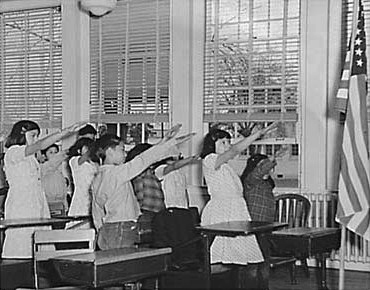
Ever hear of the Bellamy Salute, take a look at the photo and tell me what ya think and ponder why that is not talked about in this current situation,,,


The Bellamy salute is the salute described by Francis Bellamy to accompany the American Pledge of Allegiance, which he had authored. During the period when it was used with the Pledge of Allegiance, it was sometimes known as the "flag salute". During the 1920s and 1930s, Italian fascists and Nazis adopted a salute which had the same form, resulting in controversy over the use of the Bellamy salute in the United States. It was officially replaced by the hand-over-heart salute when Congress amended the Flag Code on December 22, 1942.

The inventor of the saluting gesture was James B. Upham, junior partner and editor of The Youth's Companion.[1] Bellamy recalled Upham, upon reading the pledge, came into the posture of the salute, snapped his heels together, and said "Now up there is the flag; I come to salute; as I say 'I pledge allegiance to my flag,' I stretch out my right hand and keep it raised while I say the stirring words that follow."

The Bellamy salute was first demonstrated on October 12, 1892 according to Bellamy's published instructions for the "National School Celebration of Columbus Day": (From WikiPeida)

Lets see, how many times has the Pledge been changed?
  • Original: 'I pledge allegiance to my Flag and the Republic for which it stands, one nation, indivisible, with liberty and justice for all.'
  • 1892: 'I pledge allegiance to my Flag and *to* the Republic for which it stands, one nation, indivisible, with liberty and justice for all.'
  • 1923/4: 'I pledge allegiance to **the Flag of the United States of America** and to the Republic for which it stands, one nation, indivisible, with liberty and justice for all.'
  • 1954: 'I pledge allegiance to the Flag, of the United States of America, and to the Republic for which it stands, one Nation **under God,** indivisible, with liberty and justice for all.'

Now from my understanding this resolution even if passed, has no force of law,. All it would do is express an opinion by the Michigan legislature about what the U.S. Congress ought to do. So in essence a waste of time and money!!

Should the Pledge of Allegiance include "under God"? : News : UpNorthLive.com